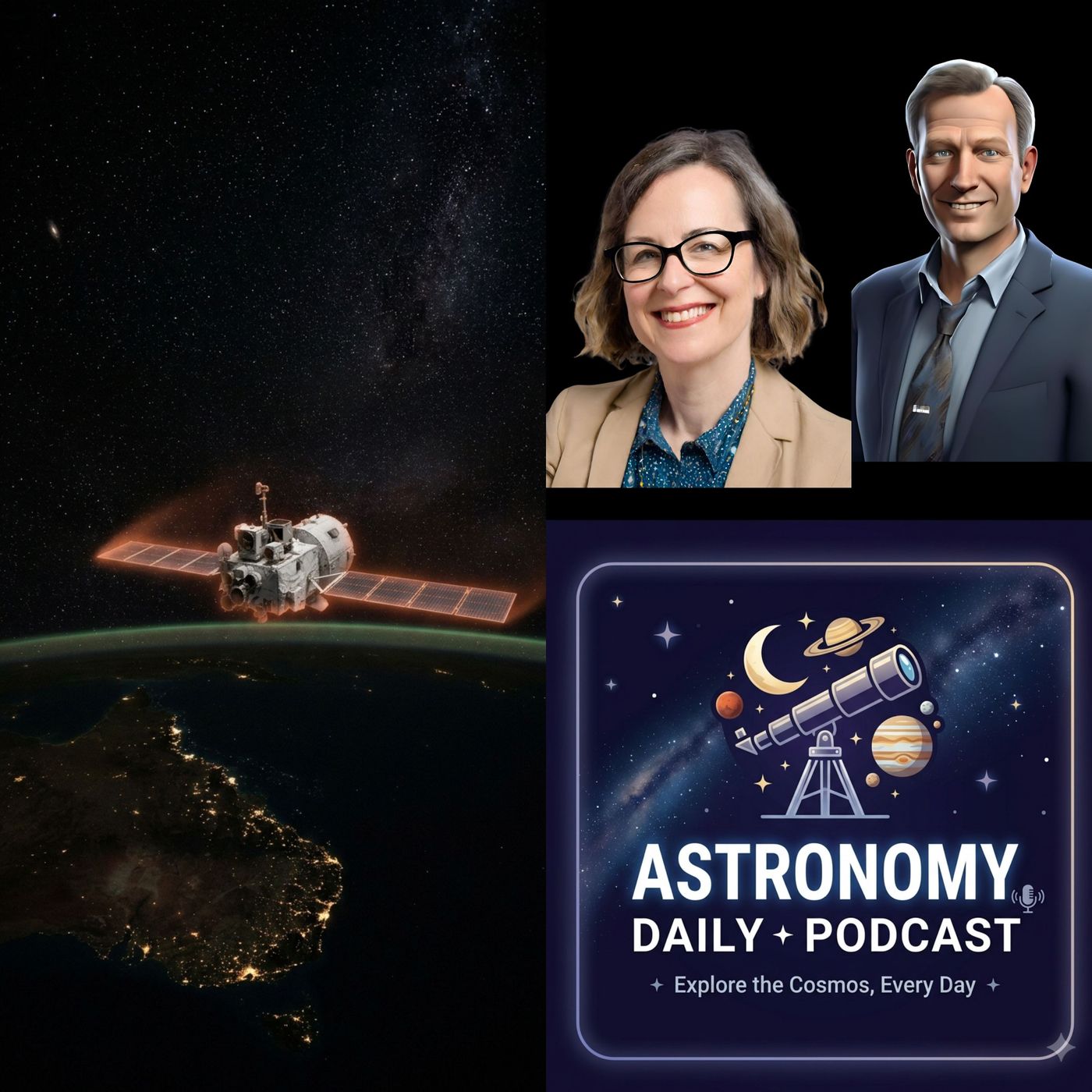
Swift’s Final Orbit: A Lost Observatory, a Burst That Defies Explanation and Rusty Interstellar Ice
Episode 221
Show notes Swift's Last Orbit: NASA's burst hunter falls home, a gamma-ray burst that is two explosions in one, and 3I/ATLAS's dusty ice. Swift's Last Orbit NASA's Neil Gehrels Swift Observatory is expected to re-enter Earth's atmosphere on Wednesday 4 November; the US Space Force prediction is about 03:30 EST (08:30 UTC, 19:30 AEDT), plus or minus 11 hours. Surviving fragments are confined between 20.6°N and 20.6°S, a band that includes northern Australia; NASA puts the risk of harm to anyone at about 1 in 2,100. We look back at 22 years of science from a two-year mission: more than 2,000 gamma-ray bursts, the first short-burst afterglow in 2005, the BOAT in 2022, and about 7,000 papers. Two Bursts, Two Births GRB 160425A, caught by Swift in April 2016, is a 1.7-second short spike, four minutes of silence, then a 51-second long burst from the same place. A Nature Astronomy paper (Li, Wang, Zhang, Cai et al., 23 October; preprint March) argues the first is merger-like and the second collapsar-like. One event, no confirmed supernova or kilonova. 3I/ATLAS's Dusty Ice Webb's NIRSpec found the interstellar comet's ice grains are about a micron across and mixed with lots of dust, resembling some trans-Neptunian objects more than familiar comets (Protopapa et al., ApJL, 26 October; preprint September).
Publisher
Astronomy Daily: Latest Space News
Link
www.astronomydaily.io
Published
November 4, 2026
Duration
23 min
Format
Podcast
Category
Issues · Science
Source
RSS feed
Host
bitesz.com
Astronomy Daily: Latest Space News
@astronomydailylatestspacenew
#swiftsfinalorbit #defiesexplanation #rustyinterstellarice #astronomy #naturalsciences
