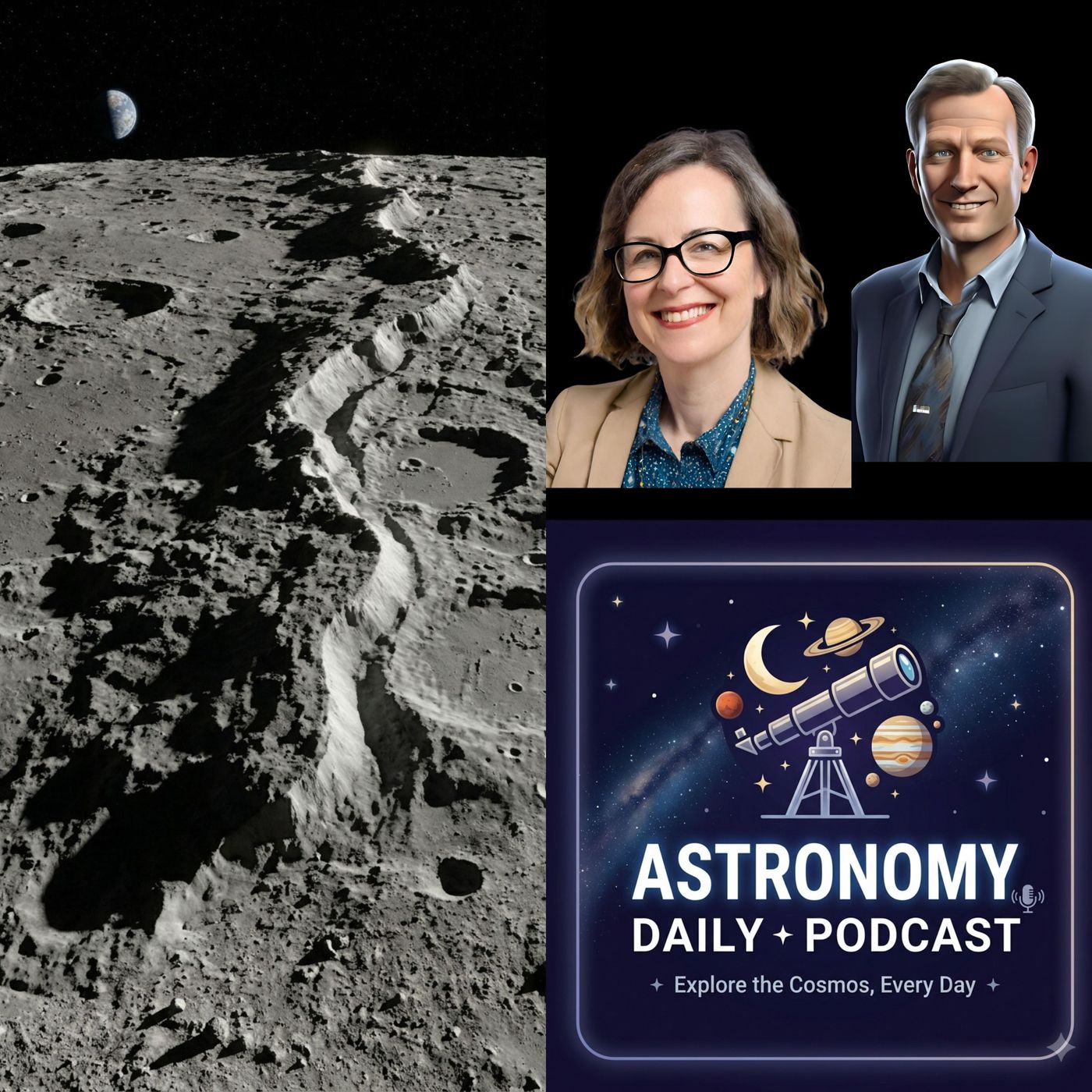
Cracking the Moon's Secrets: New Findings on Lunar Shrinkage
Episode 209
Show notes The Moon Is Still Shrinking Watters, Banks, Nypaver and Robinson (Planetary Science Journal, 14 Oct 2026) map more than 10,000 young thrust faults — ~8,900 lobate scarps and 2,000+ small mare ridges — with LRO's camera. Together they record about 42–46 m of radial contraction over the last ~400–800 million years, at most ~11 cm per million years. That's less than thermal models predict, pointing to a thick, porous, insulating megaregolith (or a strong elastic lithosphere) that delayed faulting. The ~4 MPa stress matches Apollo shallow-moonquake stress drops, so faults may still be growing today — relevant to siting lunar bases. A Soil Map for Mars University of Sydney PhD student Daniel Irving and Prof. Alex McBratney (Catena 275) classify almost 800 million Martian locations into 10 realms, 100 assemblages and 2,000 forms of 'areths', mapping 92% of the planet. Top candidate for plant growth, Nohibareth (score 0.93; ~72% clay, pH 6.8), covers 0.14% of the surface around Tharsis, Arabia Terra and Elysium. Candidates for study, not greenhouse sites; perchlorate and nitrogen not yet included. Euclid Finds Its First Comet ESA's Euclid discovered C/2026 S1 (Euclid) in Deep Field North images from 16–24 September, flagged by Mikko Pöntinen's moving-object software and confirmed by the Minor Planet Center on 8 October. ~1.3 billion km away on a steep, thousands-of-years orbit. Uranus and Neptune: Cousins, Not Twins Briand, Hue, Mousis, Cavalié et al.
Publisher
Astronomy Daily: Latest Space News
Link
www.astronomydaily.io
Published
October 21, 2026
Duration
22 min
Format
Podcast
Category
Issues · Science
Source
RSS feed
Host
bitesz.com
Astronomy Daily: Latest Space News
@astronomydailylatestspacenew
#cracking #moonssecrets #lunarshrinkage #astronomy #naturalsciences
