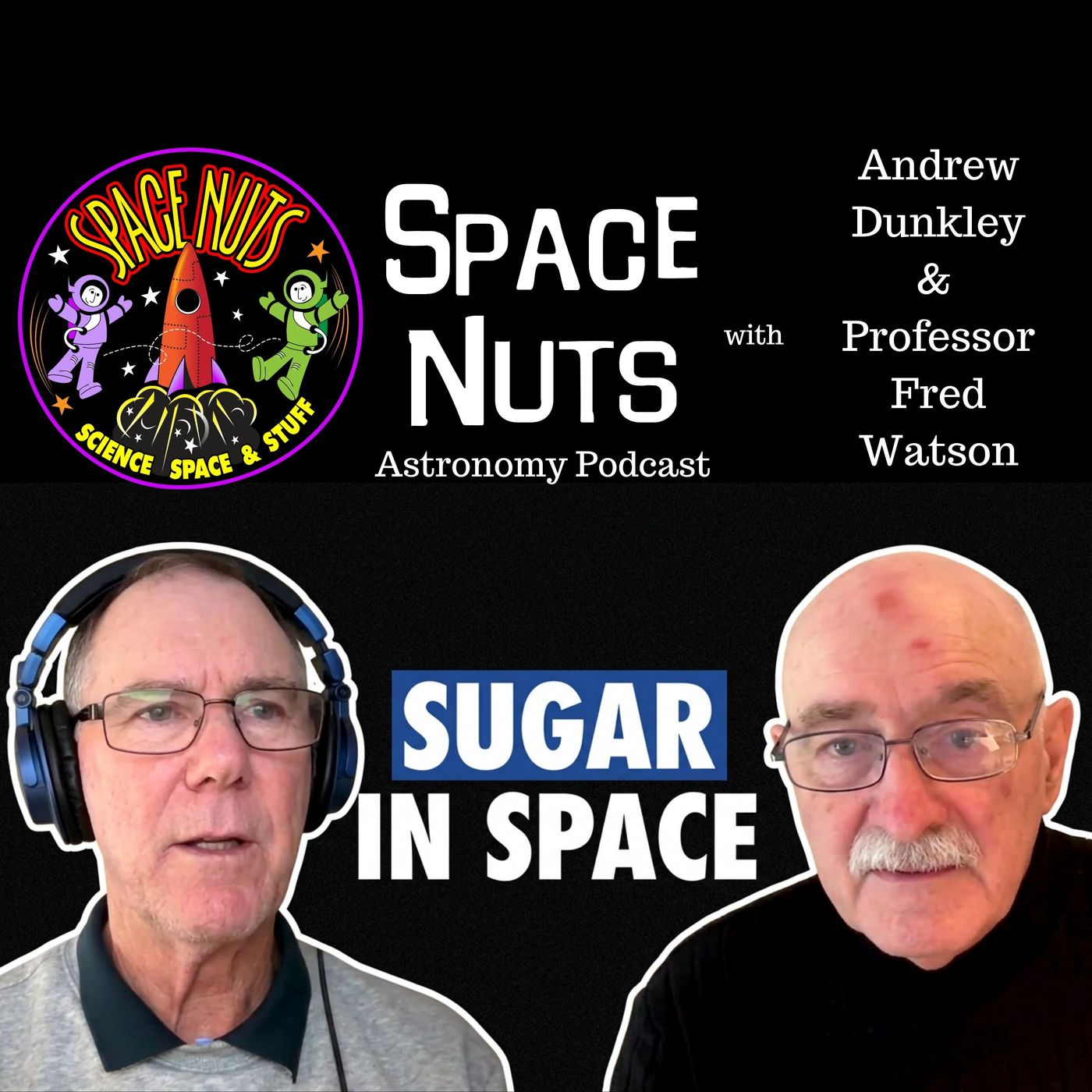
The Galaxy’s Sugary Center Could Change How Life Began
Episode 651
This episode covers three very different astronomy stories and then moves into a lively Q&A with listener questions. Andrew Dunkley and Professor Fred Watson discuss a possible sugary molecule in the center of the Milky Way, the risk lunar landers may contaminate ice that could preserve clues to life’s origins, and a new way to track lost dogs using satellite connectivity. The second half of the episode answers questions about moons with atmospheres, secret astronomy, hot Jupiters, and black hole mergers. Key topics In this episode, Fred Watson explains an update from Peter Verweyen on MOND, now referred to as Aether Scalar Tensor Theory, and how it relates to dark matter and dark energy debates. We discuss the detection of erythrulose, a sugar molecule found in interstellar gas clouds near the center of the Milky Way, and why this matters for prebiotic chemistry. Fred describes how molecules like sugar can form in cold molecular clouds before stars and planets exist, making some ingredients for life surprisingly common. We discuss a new study warning that rocket exhaust from future lunar landings could contaminate ice in permanently shadowed craters at the Moon’s south pole. The Moon’s polar ice may contain ancient prebiotic molecules delivered by comets, asteroids, and dust, making it a possible time capsule for the chemistry that led to life.
Publisher
Space Nuts: Astronomy Insights & Cosmic Discoveries
Link
www.spacenutspodcast.com
Published
August 13, 2026
Duration
28 min
Format
Podcast
Category
Issues · Science
Source
RSS feed
Host
Professor Fred Watson and Andrew Dunkley
Space Nuts: Astronomy Insights & Cosmic Discoveries
@spacenutsastronomyinsightsco
#galaxyssugarycenter #change #began #astronomy #naturalsciences
