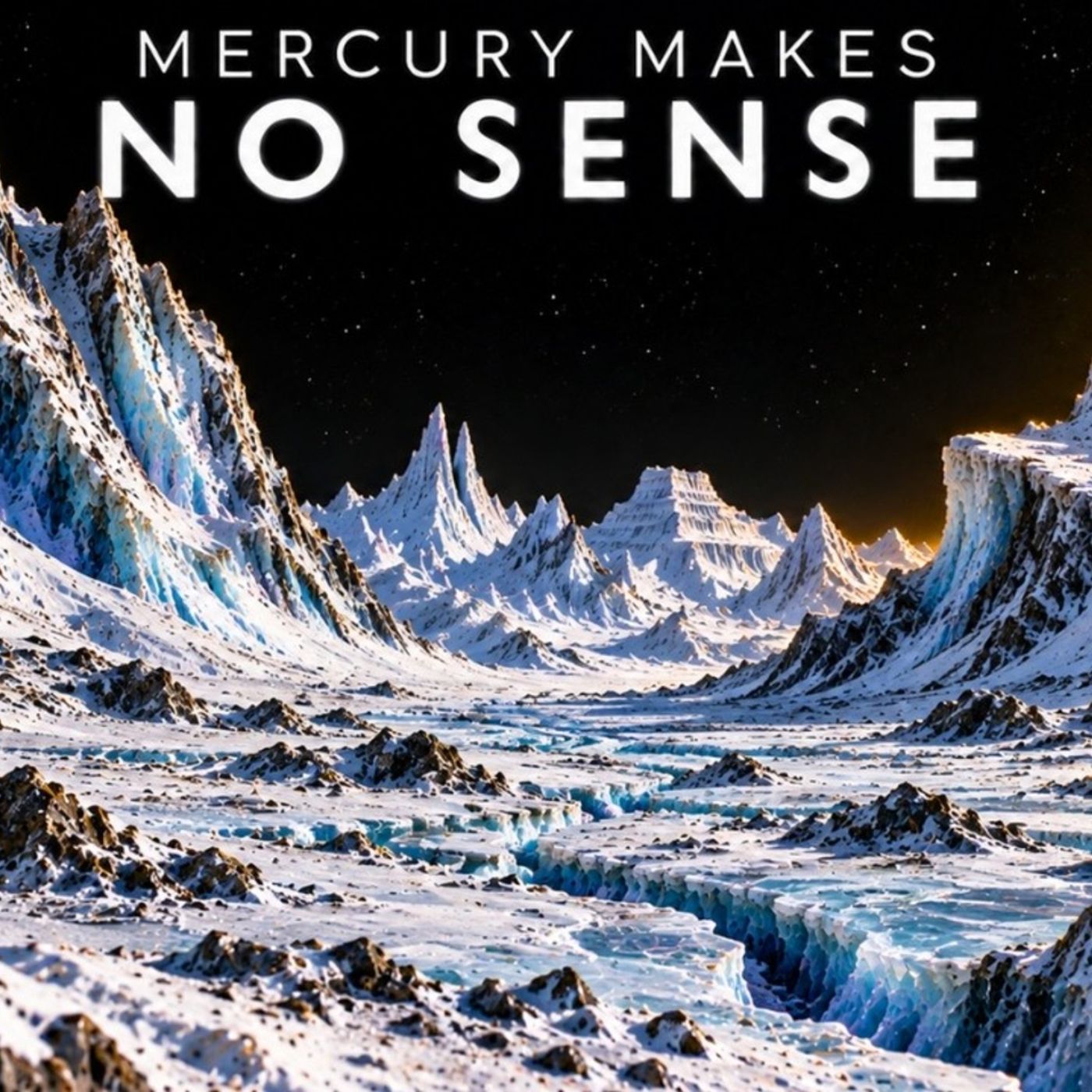
Why the Planet Closest to the Sun Is Still Colder Than Antarctica
Episode 32
Mercury is the closest planet to the Sun, yet some of the coldest places in the inner solar system are hidden within its permanently shadowed craters. In this Snoozy Space documentary, we journey to Mercury to explore one of the strangest worlds in our solar system. 🌌 Despite receiving intense sunlight, Mercury contains water ice that may have remained frozen for billions of years. Its dayside can reach around 800°F (430°C), while its night side can fall to about -275°F (-170°C). Deep inside polar craters, temperatures can plunge to roughly -370°F (-223°C). But Mercury's extremes are only the beginning. We explore how Mercury's almost nonexistent atmosphere allows its surface to experience enormous temperature swings, how intense solar wind slowly erodes the planet, and why Mercury has a faint sodium tail stretching millions of miles behind it. We also examine its enormous iron core, shrinking crust, ancient impact craters, strange surface chemistry, and the geological scars left behind as the planet contracts. Then we reach one of Mercury's greatest mysteries: how can water ice survive on the planet closest to the Sun? The answer lies within permanently shadowed polar craters, where sunlight has never directly reached for immense periods of time. These frozen environments may preserve clues about the early solar system and help scientists understand similar cold traps on the Moon and other worlds. Mercury also offers something far beyond our own solar system.
Publisher
Snoozy Space
Link
youtu.be/jlSjQ3QZSVo
Published
November 9, 2026
Duration
1h 51m
Format
Podcast
Category
Issues · Science
Source
RSS feed
Host
Mr Snoozy
Snoozy Space
@snoozyspace
#planetclosest #colder #antarctica #astronomy #physics
