Cosmic Revelations: Artemis 2's Historic Observations and the Case of Hypernovae
Episode 204
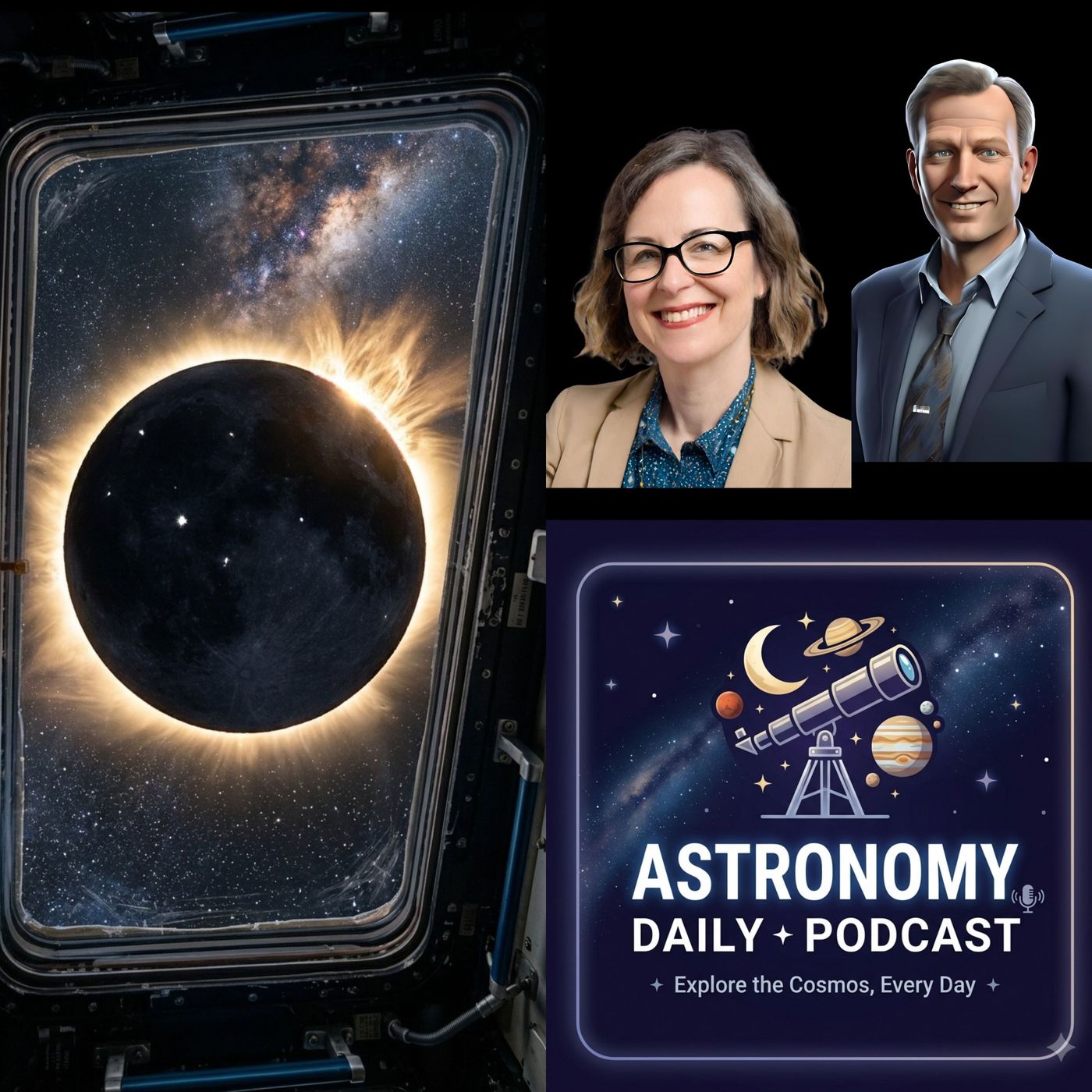
Show notes Six months after Artemis II swung around the far side of the Moon, NASA has published what the crew saw, said and sketched — including five faint impact flashes spotted during a 54-minute eclipse. Plus: two UCL papers that take apart the chemical evidence for hypernovae, Juno finds Jupiter's magnetodisk crumpled into ripples, and IISc simulations suggest magnetised white dwarfs could grow well past the Chandrasekhar limit. Skywatch: the crescent Moon meets Antares, Mercury and Venus favour the south, Mars leaves the Beehive, and Vesta at opposition. Artemis II Preliminary Lunar Science Report · Crew: Reid Wiseman, Victor Glover, Christina Koch (NASA) and Jeremy Hansen (CSA); lunar flyby 6 April 2026. · Five extremely faint impact flashes seen from ~74,000 km during a 54-minute eclipse behind the Moon; impactors estimated at no more than ~5 cm. · Crew-reported colours (blue = titanium-rich volcanic rock, brown = iron, green = glass); terminator observations as a proxy for south-pole lighting. · 'Hello, World' Earth image lit by moonlight; labelled southern Milky Way image (Crux, Carina, LMC). · Source: NASA Science, 'Artemis II: Sights & Sounds of Science', 7 Oct 2026 — science.nasa.gov/feature/artemis-ii-preliminary-lunar-science-report/ Hypernovae: the evidence that wasn't · Anmol Aggarwal & Ralph Schoenrich (Mullard Space Science Laboratory, UCL), two MNRAS papers; UCL release 5 Oct 2026.
Publisher
Astronomy Daily: Latest Space News
Link
www.astronomydaily.io
Published
October 15, 2026
Duration
25 min
Format
Podcast
Category
Issues · Science
Source
RSS feed
Host
bitesz.com
Astronomy Daily: Latest Space News
@astronomydailylatestspacenew
#cosmicrevelations #artemis2shistoric #hypernovae #astronomy #naturalsciences
