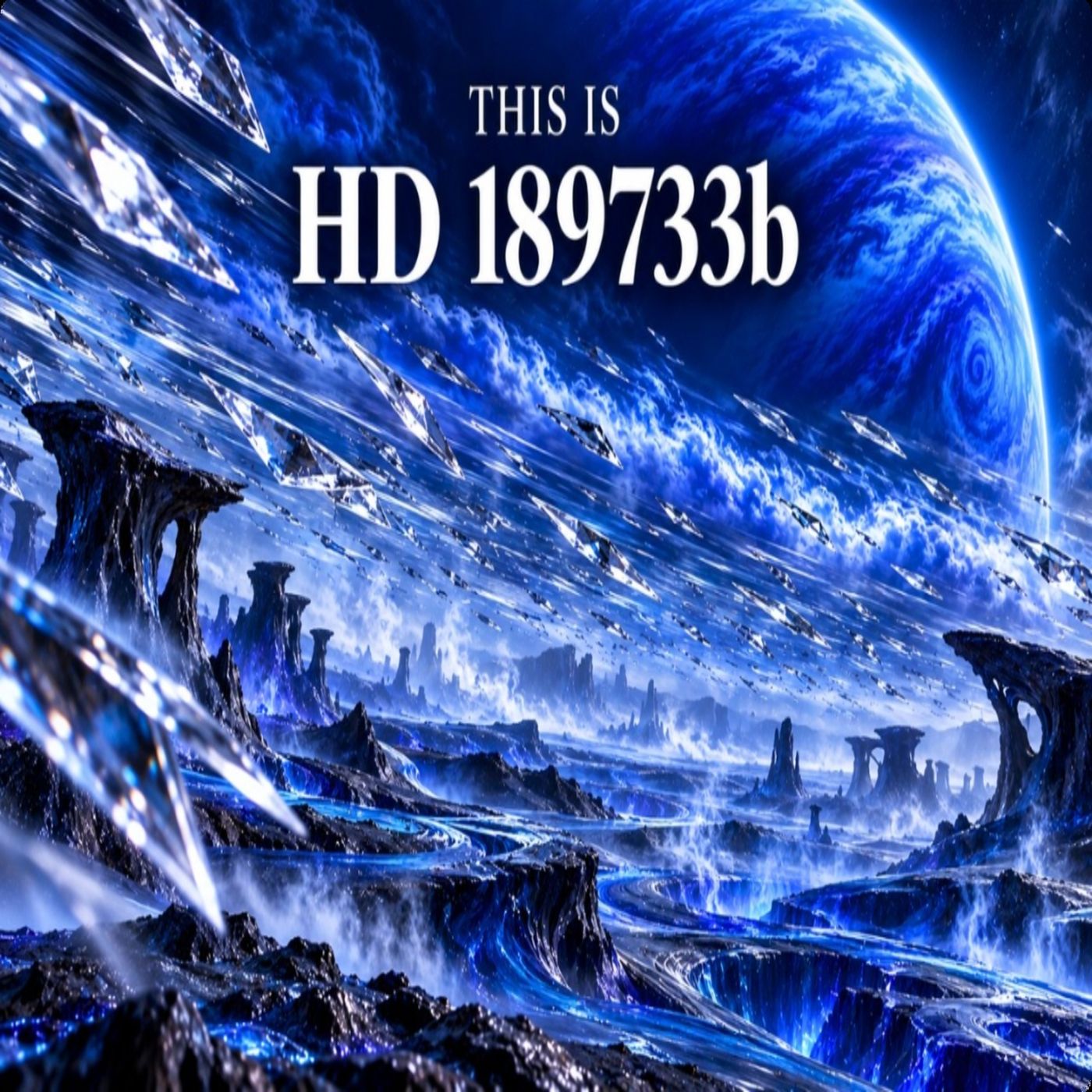
The Beautiful Blue Planet Where It Rains Glass: HD 189733b
Episode 39
Somewhere 64.5 light-years away, a gas giant shines an extraordinary cobalt blue. At first glance, HD 189733b looks almost like a distant ocean world. But the truth is far stranger. 🌌 HD 189733b is a hot Jupiter where temperatures can reach around 1,700°F, winds may race at roughly 5,400 mph, and microscopic silicate particles can be carried sideways through the atmosphere like glass rain. Its blue color is not caused by oceans. It comes from the interaction of starlight with particles in its scorching atmosphere. In this Snoozy Space documentary, we explore one of the most fascinating exoplanets ever studied, from its strange blue appearance and extreme atmospheric circulation to its glass clouds, intense heat, and the observations that allowed astronomers to study a world so distant. We’ll look at how the Hubble Space Telescope measured its visible color, how Spitzer helped map its atmospheric temperatures, and how scientists use spectroscopy, infrared observations, and phase curves to uncover the chemistry and weather of a planet that no spacecraft can reach. We’ll also explore what happens between the permanent dayside and nightside, why heat is redistributed across the atmosphere, what molecules such as water vapor, carbon monoxide, and carbon dioxide reveal about its chemistry, and why a blue planet does not necessarily mean an Earth-like or habitable world. HD 189733b is a reminder that the universe does not always produce worlds that resemble our own.
Publisher
Snoozy Space
Link
youtu.be/EdcTcH1Vxsw?si=bOVOaxOKw5U3p5fu
Published
November 16, 2026
Duration
1h 53m
Format
Podcast
Category
Issues · Science
Source
RSS feed
Host
Mr Snoozy
Snoozy Space
@snoozyspace
#beautifulblueplanet #rainsglass #hd189733b #astronomy #physics
