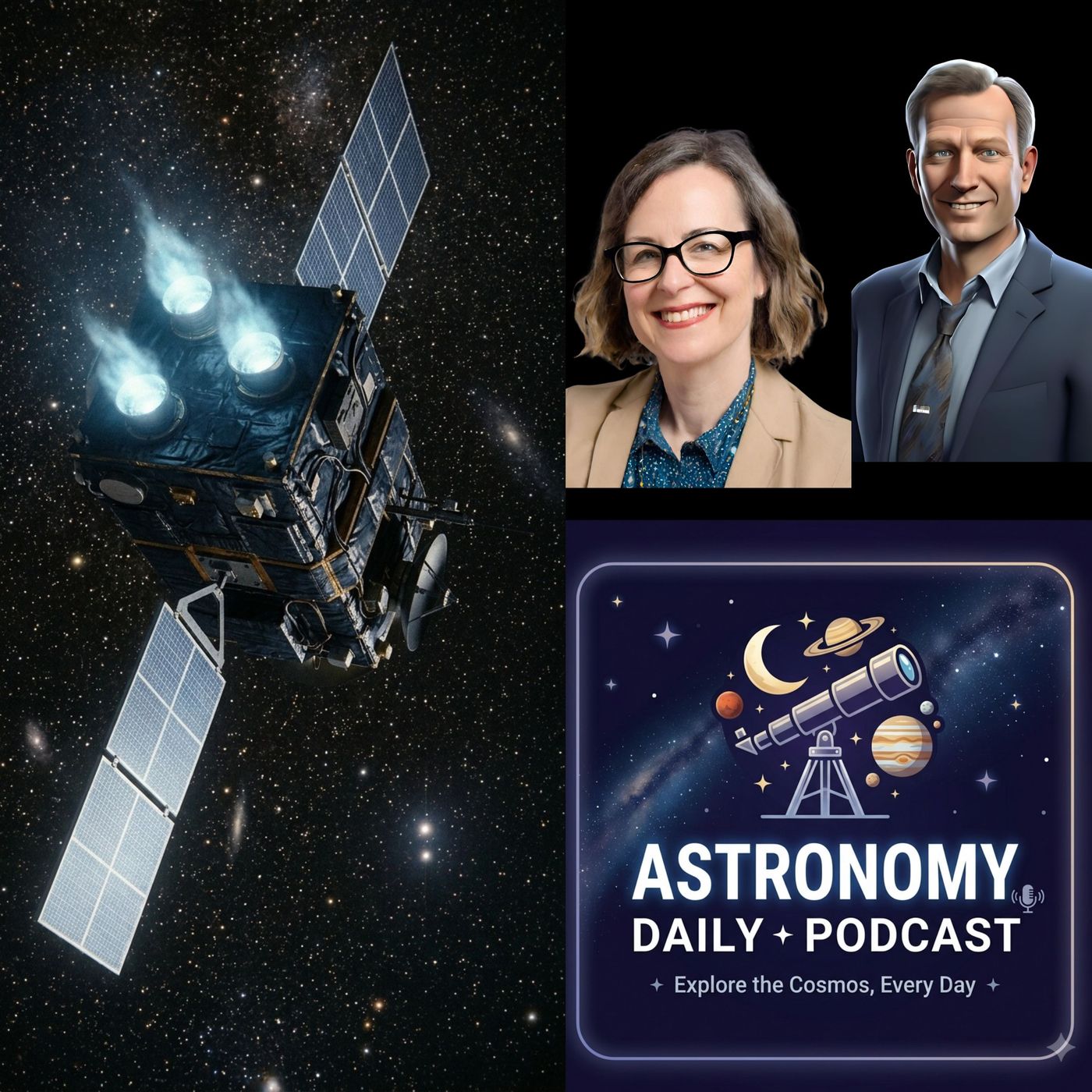
HERA's Grand Maneuver: Braking for Didymos and the Future of Planetary Defence
Episode 203
Show notes Hera Hits the Brakes ESA's Hera spotted its target asteroid for the first time last week and fires its first braking burn on Thursday — 93 minutes of thrust to start stopping at Didymos and Dimorphos, the asteroid pair NASA's DART hit in 2022. Plus: Solar Orbiter traces a solar-wind switchback back to the Sun, Gemini North finds chains of giant knots in the remnant of the supernova of 1181, Webb reads the dust of Mars-sized worlds colliding, and Perseverance becomes the farthest-driving vehicle on another world. In the skywatch: the Moon meets Antares, Venus bows out, Mars and Jupiter rule the northern dawn, and the Orionids are a week away. Hera Hits the Brakes Two years after launch, Hera caught its first glimpse of Didymos from about 236,500 km away — a sub-pixel dot. On Thursday 15 October three hydrazine thrusters fire for 93 minutes (BRM-1), taking a few hundred metres per second off its approach speed; BRM-2 (~31 min) follows on 22 October, then three small transition burns. The first signal after the burn comes through ESA's New Norcia antennas in Western Australia. Hera will measure the mass of Dimorphos so DART's single orbital-period result can become a repeatable deflection technique; its CubeSats Milani and Juventas will study dust, composition and the interior. Solar Orbiter traces a switchback home Coburn et al.
Publisher
Astronomy Daily: Latest Space News
Link
www.astronomydaily.io
Published
October 14, 2026
Duration
25 min
Format
Podcast
Category
Issues · Science
Source
RSS feed
Host
bitesz.com
Astronomy Daily: Latest Space News
@astronomydailylatestspacenew
#herasgrandmaneuver #braking #planetarydefence #astronomy #naturalsciences
