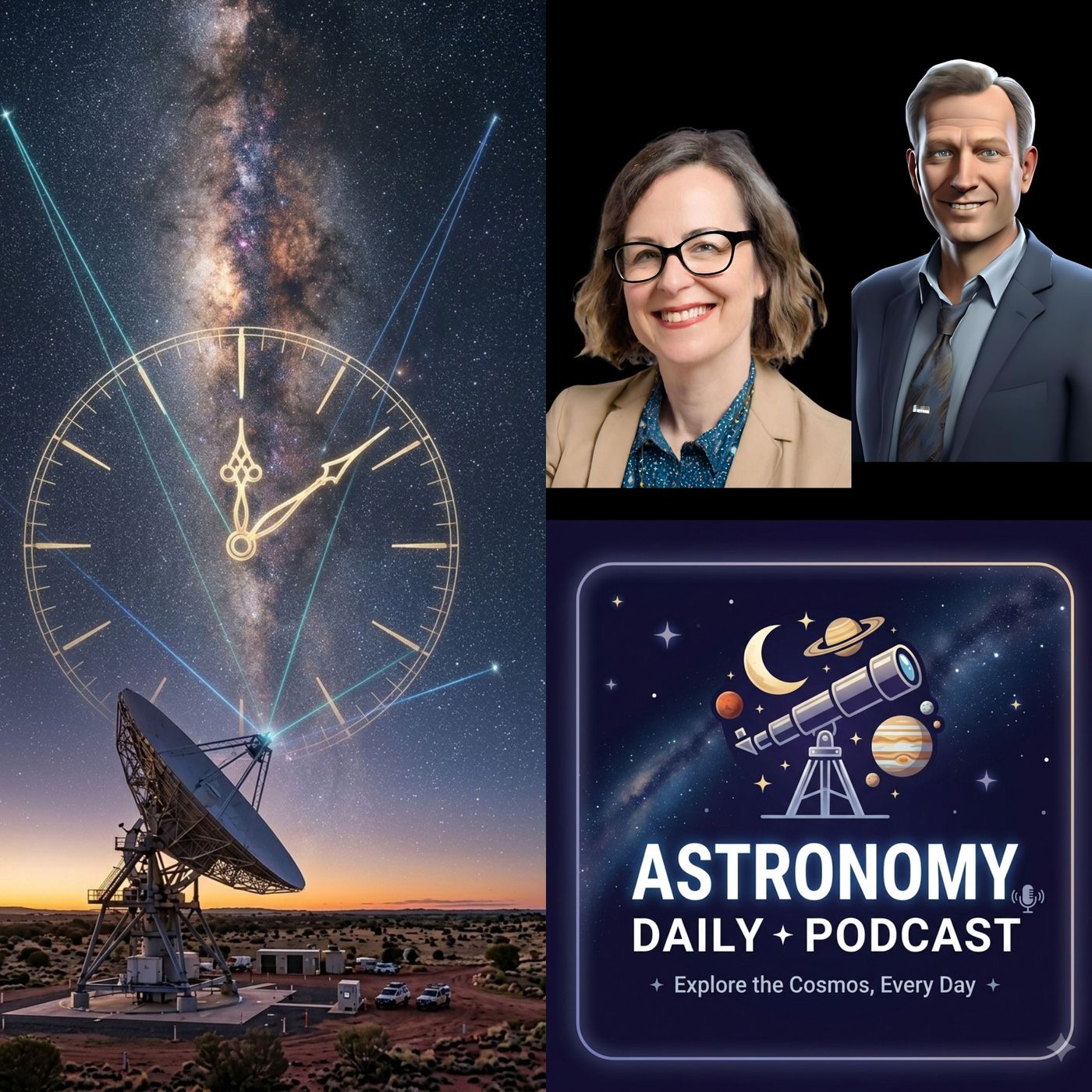
Time's Tipping Point: The End of Leap Seconds and a Lunar Clock Revolution
Episode 207
Show notes Time Lets Go of the Sky On 15 October 2026 the 28th General Conference on Weights and Measures in Versailles adopted Resolution 5: UTC becomes continuous on 20 May 2027, ending leap seconds, with the UTC–UT1 gap allowed to reach one hour. The driver: a growing chance (about 30% by 2035) of a first-ever negative leap second. Resolution 6 starts work on an international lunar reference time scale traceable to UTC; Resolution 4 prepares an optical-clock redefinition of the second for 2030. Earth's rotation (UT1) is still measured — by VLBI, with Australia's AuScope dishes part of the network. The Week That Was WISE 0855's changing water clouds (JWST); Hera's 93-minute braking burn; Artemis II's five lunar impact flashes; UCL questions the chemical evidence for hypernovae; the Arsia Mons cloud needs ice from nothing; the first green star. Also: ZTF J0440+2325, Meteor 2-7, Juno's crumpled magnetodisk, WASP-17 b, two planetary families, and new Magellanic Cloud pulsars from the Parkes archive. Skywatch First quarter Mon 19 Oct 03:12 AEDT (16:12 UTC Sun). Mercury 24° up at sunset from Sydney vs 10° LA, 7° NY, 3° London. Venus gone from northern evening skies; inferior conjunction ~03:00 UTC Sat 24 Oct. Saturn all evening, rings ~7° open. Orionids peak 21–22 Oct; Moon sets ~03:00–03:40 local, radiant 39–70° up at 04:30. Mars–Jupiter 11.5° apart, 1.2° on 16 Nov. AR4551 beta-gamma-delta. Solar safety: ISO 12312-2 filters only.
Publisher
Astronomy Daily: Latest Space News
Link
www.astronomydaily.io
Published
October 18, 2026
Duration
22 min
Format
Podcast
Category
Issues · Science
Source
RSS feed
Host
bitesz.com
Astronomy Daily: Latest Space News
@astronomydailylatestspacenew
#timestippingpoint #leapseconds #lunarclockrevolution #astronomy #naturalsciences
