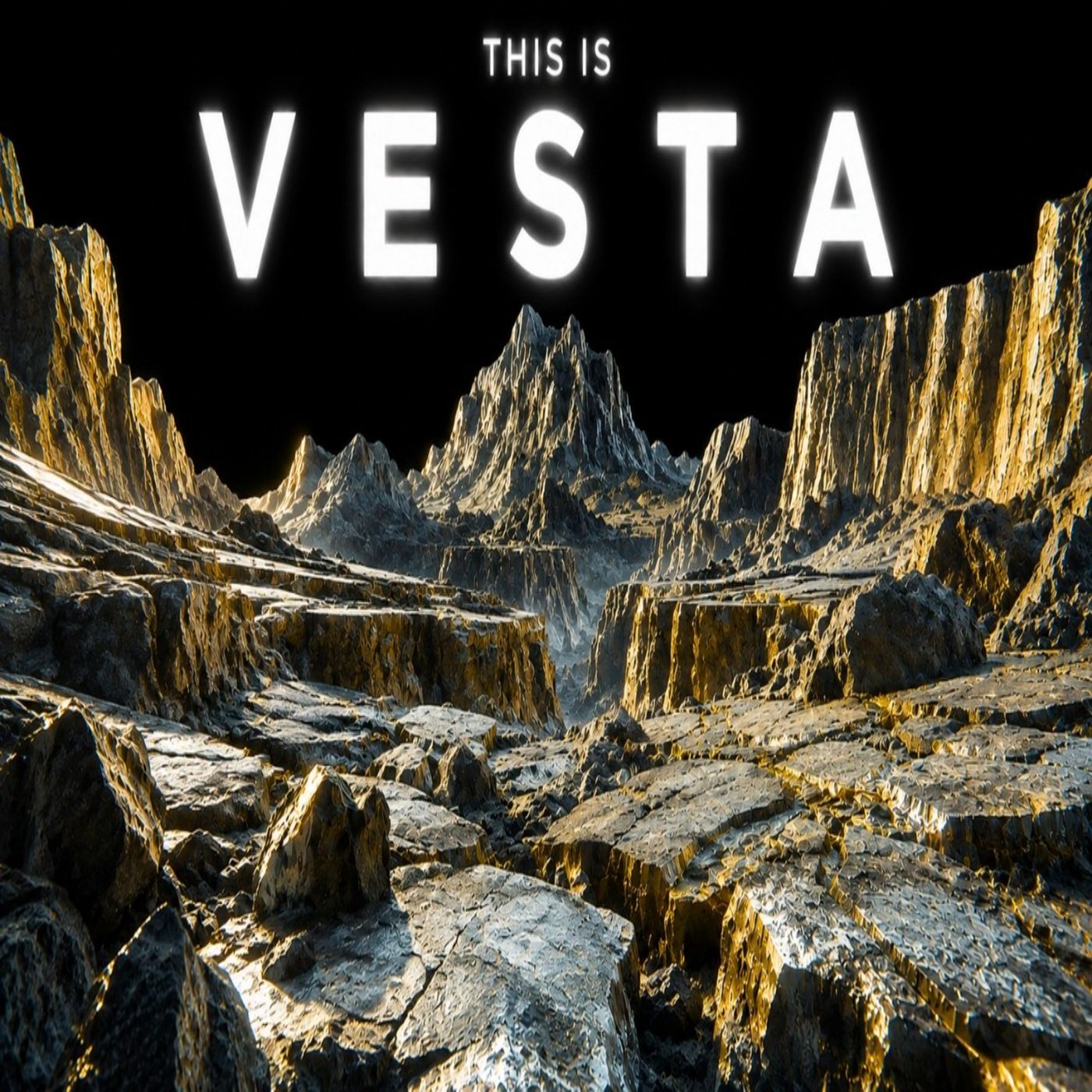
The Asteroid That Should Have Been a Planet: Vesta
Episode 20
What if an asteroid was once on its way to becoming a planet? Meet Vesta, one of the most remarkable worlds in the asteroid belt. At roughly 530 km (330 miles) across, Vesta is large enough to have developed a differentiated interior with an iron-rich core, rocky layers, and an ancient volcanic crust. Its enormous Rheasilvia basin reaches nearly 500 km (310 miles) across, while its central mountain rises about 22 km (14 miles) high, more than twice the height of Mount Everest. But Vesta's story is stranger than its size. More than 4.5 billion years ago, while the Solar System was still forming, Vesta heated up, melted, and separated into internal layers much like the early terrestrial planets. Then its growth was interrupted. Jupiter's gravity helped keep the asteroid belt from assembling into a full-sized planet, leaving Vesta preserved as an ancient planetary building block. 🌌 And the evidence didn't stay on Vesta. Massive impacts blasted material from its surface into space. Some of those fragments eventually reached Earth as HED meteorites, allowing scientists to study pieces of Vesta in laboratories and museums. When NASA's Dawn spacecraft arrived in 2011, it finally gave us a close look at the world those meteorites came from. Dawn revealed enormous impact structures, ancient basaltic rock, deep fractures, unusual surface chemistry, and a body far more complex than the word "asteroid" suggests.
Publisher
Snoozy Space
Link
youtu.be/EAaU1FUNuXk
Published
October 28, 2026
Duration
1h 53m
Format
Podcast
Category
Issues · Science
Source
RSS feed
Host
Mr Snoozy
Snoozy Space
@snoozyspace
#asteroid #planet #vesta #astronomy #physics
