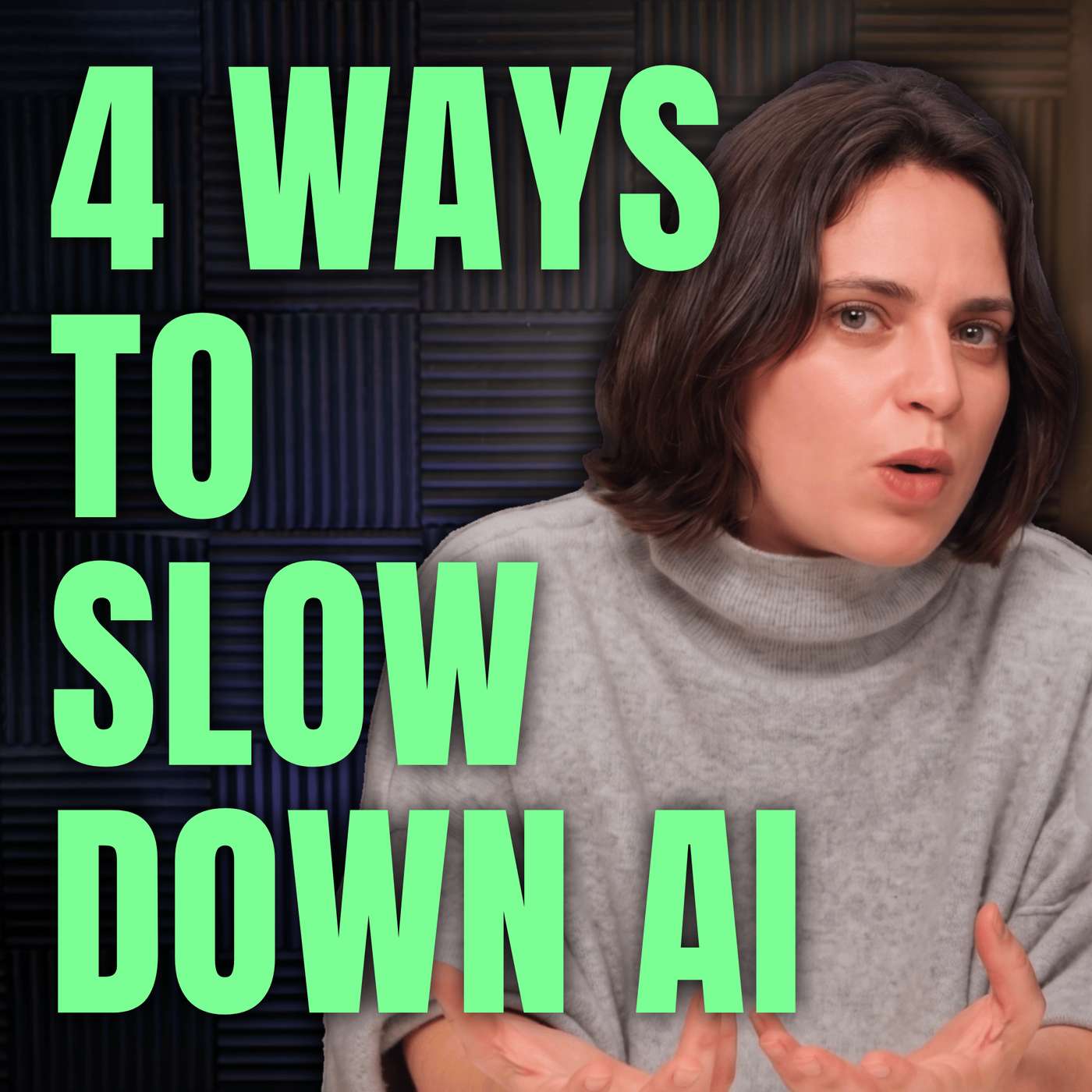
Why Silicon Valley can’t slow down AI on its own | Luisa Rodriguez
Two-thirds of Americans think AI is moving too fast. So do the people building it. So why the hell isn’t anyone slowing down? We can’t tell when models are too dangerous. We mostly don’t know how they work. We don’t know how to make them do what we want. And our two main safety checks — testing behaviour and monitoring their ‘thoughts’ — are breaking down. Yet we’re racing to build more powerful AI anyway, faster every year. And it’s only going to accelerate as AI itself gets better and better at building the next generation of models. Earlier this year, OpenAI found its new model, Astra, was alarmingly good at hacking, and did something companies almost never do: paused its biggest training project. But it released Astra anyway, even though tests couldn’t prove if it was safe. That’s the problem with leaving it up to the companies. We can’t trust them to act in our best interest because the competitive pressures for them to race ahead are too strong. So what’s the solution? Luisa Rodriguez evaluates the likely candidates: Safety checkpoints when new models can hack, work unsupervised, or build bioweapons Restricting computing power as a speed limit on AI development Preventing AI from being used to create more powerful AI Pausing development altogether None of these will be easy. But with AI hacking increasingly widespread, we’re already seeing the consequences of doing nothing — and this is just the beginning.
Publisher
80,000 Hours Podcast
Link
80000hours.org/podcast/episodes/ai-slowdown-why-how/?utm_campaign=podcast__luisa-rodriguez&utm_source=80000+Hours+Podcast&utm_medium=podcast
Published
October 27, 2026
Duration
21 min
Format
Podcast
Category
Lifestyle · Education
Source
RSS feed
Host
The 80,000 Hours team
80,000 Hours Podcast
@80000hourspodcast
#siliconvalleycant #luisarodriguez
