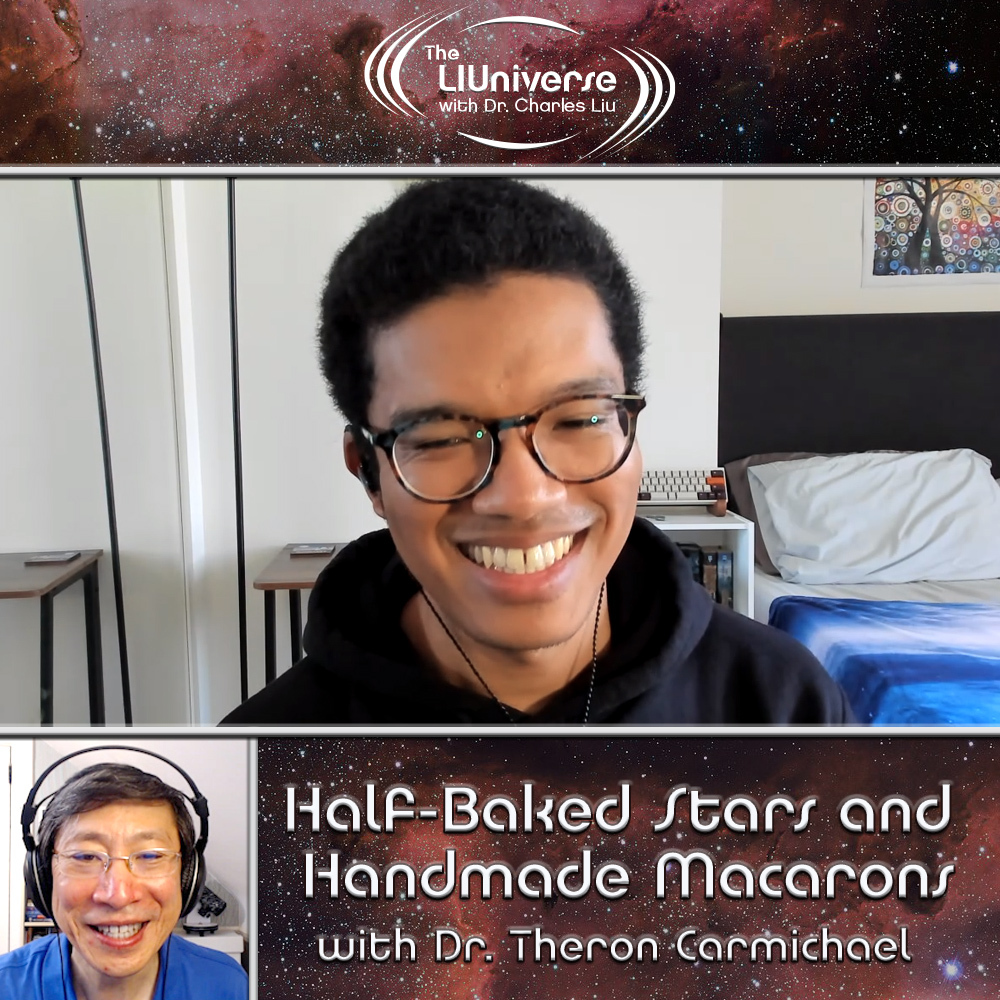
Half-Baked Stars and Handmade Macarons with Dr. Theron Carmichael
 The LIUniverse with Dr. Charles Liu
What is a transiting brown dwarf, why are they so rare, and how do you find them? Equally important, how do you make a good French macaron? To find out, Dr. Charles Liu and co-host Allen Liu welcome astronomer and astrophysicist Dr. Theron Carmichael. As always, though, we start off with the day’s joyfully cool cosmic thing: a recent paper in the Astrophysical Journal possibly linking a supernova that took place millions of years ago and bombarded Earth with cosmic rays and radioactive iron with a flurry of virus mutation that took place in deep ancient lakes on our planet. After Theron brings up the Chicxulub meteor impact (the one that spelled trouble for dinosaurs) and how astronomical events can affect the evolution of life here on Earth, we naturally turn to the effects of extreme radiation events and… the mighty Marvel mutants themselves, the X-Men! Then it’s time to talk about Dr. Carmichael’s bread and butter: detecting and categorizing transiting brown dwarfs, an exceedingly rare form of the “failed stars” which actually orbit other stars. Theron explains that while we know how stars and planets form, we don’t exactly understand the formation of brown dwarfs, which exist in the gray region between a star and a planet. Allen reminds us how protoplanetary discs form, while Theron points out that the distinctions may not be as clear as we used to think. Our first student question comes from Ani, who asks, “There are a lot more small, faint stars than big bright stars.
Publisher
The LIUniverse with Dr. Charles Liu
Link
theliuniverse.podbean.com/e/half-baked-stars-and-handmade-macarons-with-dr-theron-carmichael/
Published
March 8, 2025
Duration
37 min
Format
Podcast
Category
Issues · Science
Source
RSS feed
Host
theliuniverse
#bakedstars #handmademacarons #theroncarmichael #astronomy #sciencefiction
