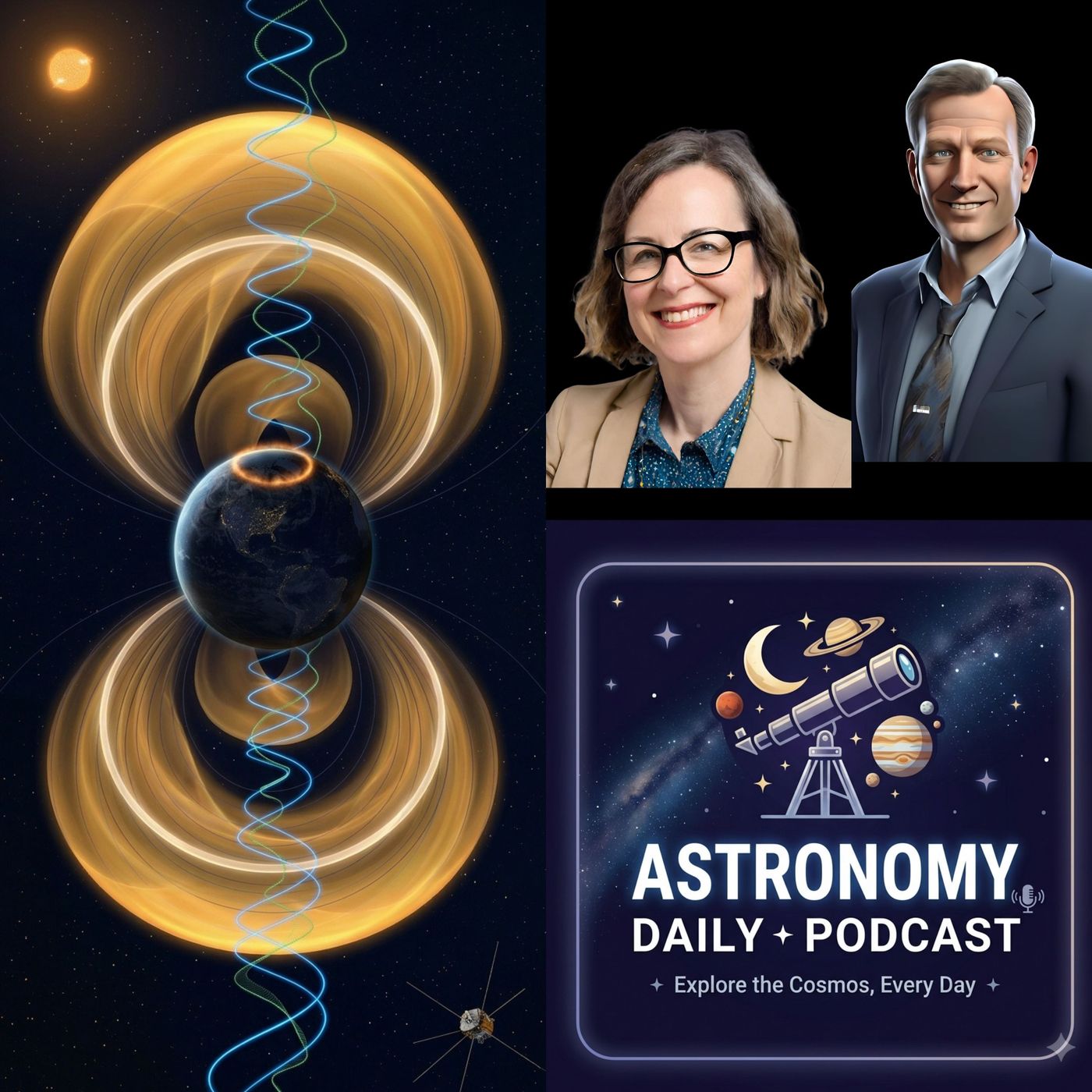
The Impenetrable Wall That Failed: Killer Electrons Made Inside Earth’s Radiation Belt
Episode 219
Show notes Electrons made on the wrong side of Earth's 'impenetrable barrier', a gamma-ray burst that only looked weak, the week that was, and a Halloween that is astronomically a week early. The Wall That Broke In 2014 NASA's Van Allen Probes revealed a sharp inner edge to Earth's outer radiation belt: electrons at the very highest energies never got closer than about 2.8 Earth radii. During the May 2024 superstorm — the biggest since the 2003 Halloween storms — Japan's Arase satellite saw electrons of about 3 MeV rise deep inside that 'impenetrable barrier'. A new paper led by Yoshizumi Miyoshi (Nagoya University ISEE) shows a peak in electron phase space density growing in place at L* ≈ 3, about 12,000 km up — evidence the electrons were accelerated there rather than carried in. Intense chorus waves, operating in a region emptied by a crushed plasmasphere and a negative ionospheric storm, are the likely engine. Caveats: one storm; 'consistent with' chorus acceleration; the breach itself had been reported before — the new part is the mechanism. Not Faint, Just Side-On GRB 260310A, caught by Fermi on 10 March 2026, had a feeble gamma-ray flash but one of the brightest afterglows ever seen. Yu-Han Yang (Tor Vergata) and colleagues argue we viewed a two-component jet from the side. Preprint from May; published in ApJL this month; competing models exist.
Publisher
Astronomy Daily: Latest Space News
Link
www.astronomydaily.io
Published
November 1, 2026
Duration
22 min
Format
Podcast
Category
Issues · Science
Source
RSS feed
Host
bitesz.com
Astronomy Daily: Latest Space News
@astronomydailylatestspacenew
#impenetrablewall #killerelectrons #earthsradiationbelt #astronomy #naturalsciences
